

What is CCTV? Meaning, how it works, and the three types
 By Muhammad Talha · Product Manager and CTONine years building computer vision and automated surveillance systems · Updated
CCTV stands for closed-circuit television: security cameras that send their video to a private recorder and a limited set of screens, rather than broadcasting it. In the United States it is just as often called video surveillance or simply security cameras. This article explains what the term means, how a CCTV system works, the three types you will meet, and what changes when the recording moves from a box in the building to the cloud.
What does CCTV stand for, and why “closed circuit”?
CCTV is short for closed-circuit television. Wikipedia defines it as “the use of closed-circuit television cameras to transmit a signal to a specific place on a limited set of monitors”, and notes that it “differs from broadcast television in that the signal is not openly transmitted”.
That is the whole meaning of “closed circuit”: the video travels only to the people and equipment meant to see it. The cameras, the cabling and the recorder form a closed loop. The name dates from the analog era, but it has stuck to every kind of security camera system since, including ones that record over the internet.
How does a CCTV system work?
Every CCTV system has the same four parts, whatever its age:
- Cameras capture the scene and turn it into a video signal: analog over coaxial cable, or digital over a network.
- Cabling or a network carries that signal from each camera to the recorder.
- A recorder stores the video. A DVR (digital video recorder) takes analog cameras and digitizes them; an NVR (network video recorder) takes IP cameras. Both write to their own hard disks.
- Screens and apps show the cameras live and play back what was recorded, on a monitor on site or on a computer or phone.
Storage is where systems differ most. As Wikipedia puts it, cameras “can either store the images on a local hard disk drive, an SD card, or in the cloud.” Recorders have long added features on top of storage too: Wikipedia notes that DVR-based systems offer “extra features (such as motion detection and email alerts)”.
What are the types of CCTV?
By how the video is carried and kept, there are three:
- Analog CCTV: cameras on coaxial cable, recording to a DVR in the building. The oldest and still common, especially where the cabling has been in the walls for years.
- IP CCTV: network cameras on Ethernet, recording to an NVR. Usually higher resolution, and each camera is a device on the network with its own address and video stream.
- Cloud CCTV: cameras record to storage outside the building, viewed in a browser or app. Nothing on site holds the only copy of the footage.
You will also see CCTV cameras grouped by shape and job: domes for ceilings, bullets for walls and long views, and PTZ cameras that pan, tilt and zoom. Those are camera types; the three above are system types, and they decide where your footage lives.
CCTV vs IP camera vs security camera: what is the difference?
Mostly vocabulary. “Security camera” is the everyday word for the device. “CCTV” is the older name for the whole system, and some people use it to mean analog specifically. An IP camera is a digital camera that sends its video over a network, usually as an RTSP stream and often speaking ONVIF, the standard that lets cameras and recorders from different makers work together.
The distinction that matters in practice is not the name but the stream: an IP camera, or a recorder that publishes a stream for each camera, can be connected to other software, including cloud recording, without replacing anything on the wall.
What is CCTV footage, and how long is it kept?
CCTV footage is simply the recorded video. It is kept for a retention period and then overwritten or deleted. On a DVR or NVR that period is whatever the disks hold: when they fill up, the oldest video goes first, for every camera alike.
How long it should be kept is set by your sector, your insurer and the privacy rules that apply to you, not by the hardware. Video retention requirements covers how to decide it, and video retention defines the term.
What is CCTV used for, and does it work?
Businesses use CCTV for three things:
- Deterrence: visible cameras discourage theft, vandalism and trespass.
- Evidence: recorded video of an incident for the police, an insurer or an internal investigation.
- Operations and safety: watching loading docks, production lines, car parks and other places where something going wrong is costly.
The evidence on crime is more mixed than the marketing suggests. Wikipedia cites a 2019, 40-year systematic review which found that “the most consistent effects of crime reduction of CCTV were in car parks”, and a 2008 report by UK police chiefs which “concluded that only 3% of crimes were solved by CCTV.” A system that only records can help only after the fact, once someone goes looking through the footage, which is why camera systems increasingly add detection and alerts on top.
Where traditional CCTV falls short
The weak points of a recorder-in-a-cupboard system are well known to anyone who has needed footage in a hurry:
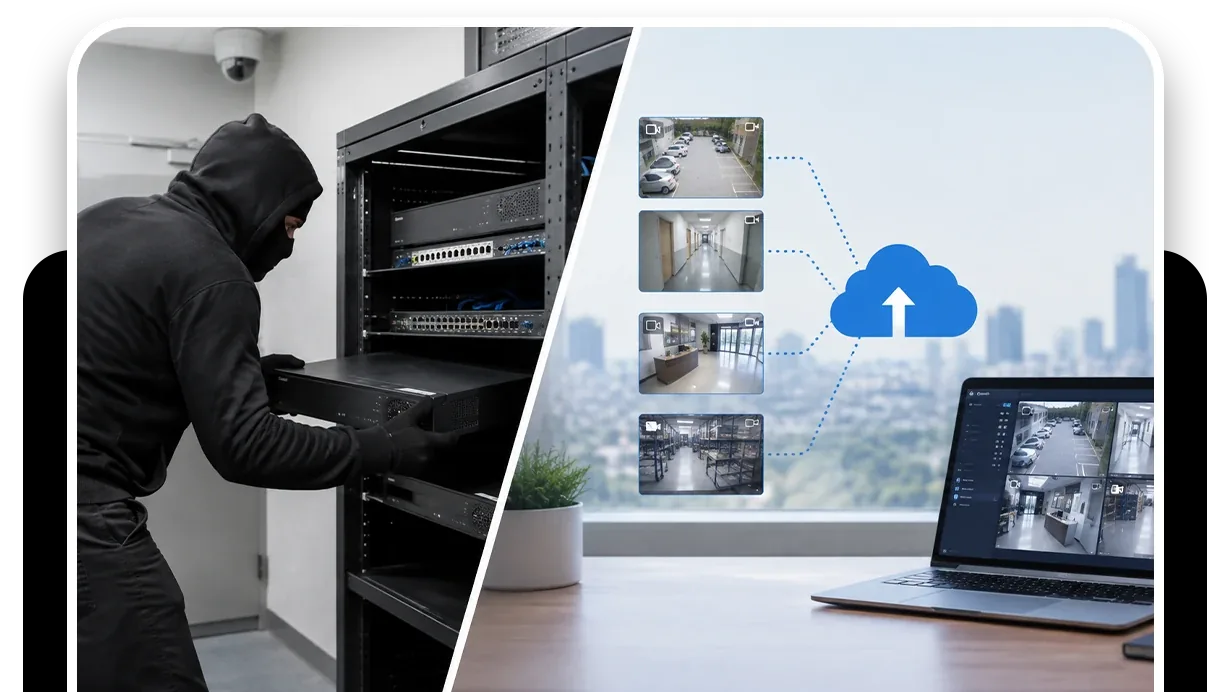
- The recorder holds the only copy. If it is stolen, damaged or its disk fails, the footage goes with it.
- Nobody is watching. Cameras record everything and alert on little, so incidents are found the next morning.
- Every site is its own island. A business with several locations has several recorders, each with its own login and its own retention.
- No one can show the cameras were checked. A recorder keeps video, not a record that someone looked at the gate at 2am.
Each of these has a cloud answer: footage kept off site, AI detections that raise the events that matter, one console for every site, and scheduled patrol rounds that leave a report.
From CCTV to cloud video surveillance, on the cameras you have
Moving CCTV to the cloud does not mean new cameras. Camzify connects any camera that publishes an RTSP stream or answers ONVIF, and RTMP and HTTPS streams too, regardless of the NVR or DVR brand behind them. Cameras on a private network connect through the Camzify Connector, with no port forwarding.
- Recording: each camera records to the cloud continuously or on a schedule, kept in Amazon S3 in the AWS region nearest your sites.
- Retention per camera, in days or as a storage cap, so the gate can keep ninety days while a corridor keeps seven.
- 23 AI detections on top of the recording, from intrusion and loitering to fire and smoke, with alerts reaching the assigned person within seconds of a confirmed detection.
- Every site in one browser console, with scheduled patrol rounds that file a report with a compliance percentage.
Pricing is per camera per month, from $5. For the wider picture, read cloud video surveillance and using existing cameras with a cloud VMS.
Sources, checked 17 October 2026
- Wikipedia: Closed-circuit television: the definition, the history, storage options, DVRs and NVRs, and the findings on crime quoted above.
Put your CCTV cameras on the cloud
See cloud recording, AI detections and patrol rounds on real cameras in a 15-minute demo, and get a quote for your camera count.