

License plate reader software for your security cameras
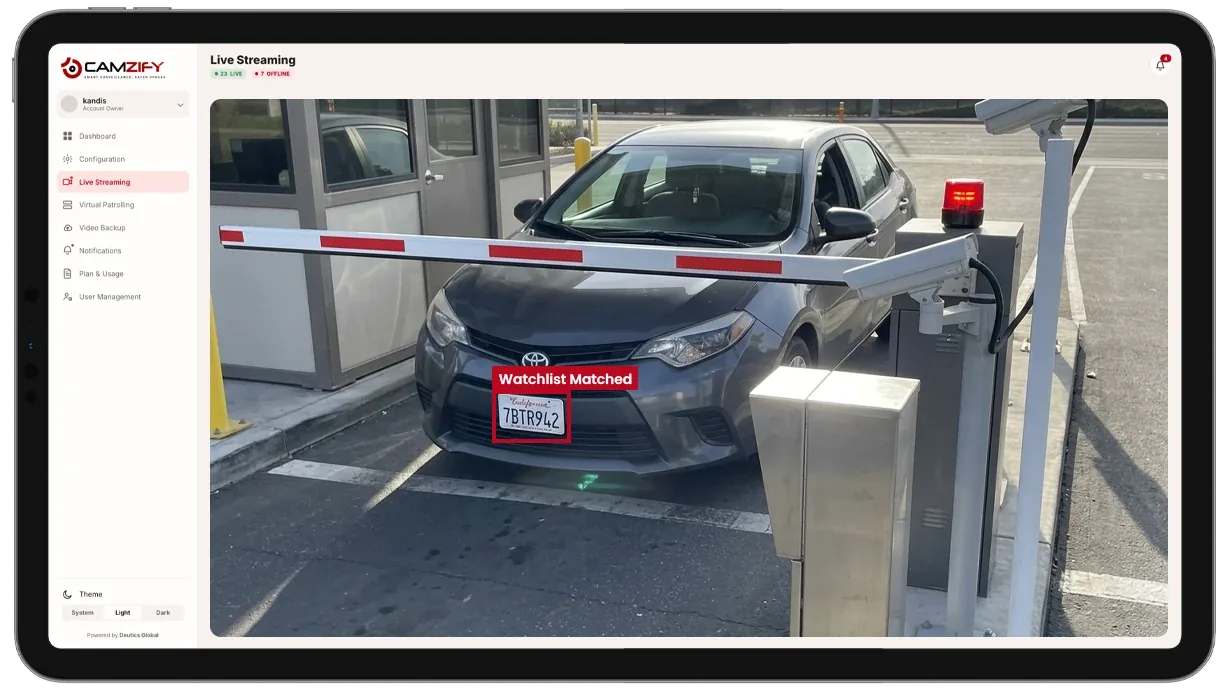
Camzify's license plate recognition (LPR, also called ALPR) reads vehicle plates from the security cameras you already have and alerts you when a plate on your watchlist is seen. It reads US and Singapore plates today. It is a custom detection, set up for your site, rather than one of the 23 standard detections.
- US and Singapore plates
- Watchlist alerts
- Cloud or on premises
What it does
- • Reads the plate of a vehicle in the camera frame and turns it into text
- • Checks each plate against a watchlist of plate numbers you keep
- • Notifies the people you designate when a listed plate is recognized
- • Reads US and Singapore plates
What it does not do
- • Read plates from other countries yet: those would be scoped as a new build
- • Identify the driver: it reads the plate, not the person
- • Read a plate the camera cannot see clearly: framing matters, see below
Know when a particular vehicle is back
The watchlist is a list of plate numbers you keep: a vehicle banned from a car park, one linked to an earlier incident, one you have been asked to look out for. When a camera reads a plate on the list, the people you designate are notified.
License plate reader, LPR, ALPR, ANPR: the same job
The names differ by market and vendor, not by what the technology does. In the US it is a license plate reader, LPR or ALPR (automatic license plate recognition); in the UK, Australia and India it is usually ANPR (automatic number plate recognition). Each reads the plate from the camera image and checks it against a list. Camzify reads US and Singapore plates today (see Camzify in Singapore), so for UK or Australian plates it would be a new build.
The real choice is between a dedicated plate-reading camera and software that reads plates from the video of cameras already in place. Camzify is the second kind: it runs on any camera whose stream reaches the platform, from any of the camera brands it connects to, so long as the plate is legible in the frame.
Gates, entry lanes and car park barriers
Plate recognition earns its place where every vehicle passes one point: the gate of a residential community, the barrier of a parking facility, the entrance to a warehouse yard or a dealership lot. A vehicle on the watchlist is flagged as it arrives, with the frame and the time, rather than found later in footage.
Which cameras can read plates
Plate reading asks more of a camera than spotting a vehicle does, because the characters have to be legible in the frame. A camera on a gate, a barrier or an entry lane, where vehicles pass close and slowly, is usually framed for it. A wide view over a whole car park usually is not, and it keeps doing the job it was placed for: tracking vehicles as objects and flagging a vehicle parked where it should not be. Which of your cameras suit plate reading is checked when the detection is set up.
Where it runs
In the cloud or on premises, the same choice as the rest of the platform. See the deployment options.
How it is priced
As a custom detection: quoted per site, and licensed per camera once it is live, one detection instance for each camera it runs on.
Frequently asked questions
See the detections on live cameras
A 15-minute demo of the live product: the detections your site needs, running on real camera feeds, and a quote per camera for your sites.