

A virtual guard watches the site through its cameras
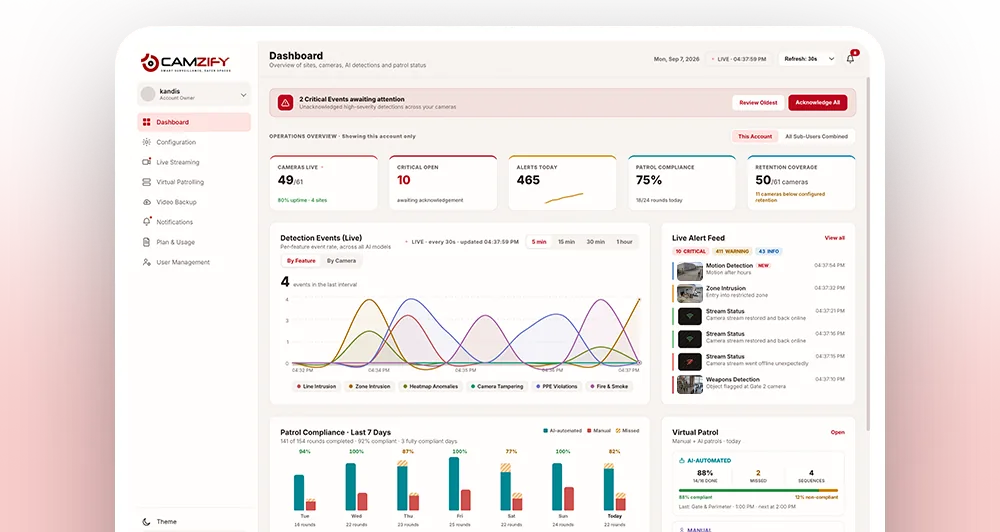
A virtual guard is security cover delivered through a site's cameras rather than by a person standing on it: scheduled patrol rounds that check a list at every camera, AI detections that watch between rounds in the hours you set, a person notified the moment something fails, and a report with the frame behind every result. Camzify is the software that does this. The security agency or monitoring company running it is the guard.
- Runs on the cameras you have
- A person notified on every failure
- Evidence on every check
Three things people mean by “virtual guard”
The phrase is used loosely. It helps to know which of the three you are being sold, because they cost differently and leave different records behind.
A person watching remotely
An operator in a monitoring room with the site's cameras on a wall, reacting to alarms and to what they notice. This is what most providers call remote guarding. The cover is as good as the operator's attention across every screen they have.
Remote guarding costSoftware running rounds
A scheduled round steps through the cameras in order, answers a checklist at each stop from the frame, notifies the person responsible on a failure and files a report. Nobody has to be watching for the round to happen. This is virtual patrolling.
Virtual patrollingBoth, with detections in between
The rounds run on schedule, AI detections watch every camera between them in the notification window set for each, and an operator or a guard takes what needs a person. This is how Camzify is deployed by agencies and monitoring companies.
For security agenciesWhat a virtual guard does overnight
At the scheduled time the round starts at the first camera in the sequence and works through the checklist for that stop: gate closed, no person in the yard, dock door shut, camera view clear. Each item is marked from the frame and the frame is kept. A failed item sends the message written for it to the guard designated for that camera, and the round records whether it was fixed.
Between rounds the AI detections enabled on each camera keep watching. Detection runs all the time; the notification window decides when a detection becomes a message, so a person in the loading bay notifies at 02:00 and stays quiet at 14:00. When the last round finishes, the report is filed: every stop, every item, every result, and who was told.
- Dock door 1 closedNot compliant
- No person on the apronCompliant
- Forklift parked in bayCompliant
- Camera view unobstructedCompliant
A failed item is resolved as Fixed or Pending before the round can close.
- 01Site cameras
- 02Camzify rounds and detections
- 03Agency or monitoring room
- 04Guard attends
The guard is a company. Camzify is what it runs.
If you manage a site, a virtual guard service is usually sold to you by a security agency or a monitoring company, who run the rounds, take the notifications and send a person when one is needed. Camzify is the console they do it on: one account, a scoped login and a report per client, the guard messaged from inside the round.
If you are that agency or monitoring company, this is the offer you can put on the cameras your clients already have, priced per instance per month rather than per hour. The security agencies and monitoring companies pages cover the account model, and the selling guide covers the pitch. Sites that want to run it themselves can; the console does not care who is logged in.
Where each one is better
A person on site can open a door, calm a situation and call an ambulance. A virtual guard cannot, and this table says so. The full comparison is on virtual patrolling vs security guards.
| Capability | Virtual guard on Camzify | Guard on site | Cameras recording only |
|---|---|---|---|
| Cover between rounds | AI detections on every camera, in the notification window you set | Whatever the guard happens to see or hear | Recording only; reviewed after the fact |
| The patrol round | Every camera, every item, on schedule, identical at 03:00 and 15:00 | Depends on the person, the weather and the hour | None |
| Record of each check | Result, timestamp and the frame it was judged from | A logbook entry or a checkpoint tap | None |
| Physical response on site | Requires a guard on call; the virtual guard tells them when | Immediate, if the guard is nearby | None |
| Judgment on the unexpected | Raises what it sees as critical; a person decides | Human judgment on the spot | None until reviewed |
| Cost basis | Per camera, quoted for the site | Per hour, whether or not anything happens | Hardware and storage |
What a virtual guard will not do
It will not attend. It will not see a corner without a camera, or through a lens that is dirty, dark or pointed at the wrong thing, which is why camera view is a checklist item on every stop. It will not decide what to do about what it finds; it tells a person, with the frame, and the decision is theirs. And it will not run without a link to the cameras: an outage is a missed round in the log, never a silent one.
We do not publish detection rates, response times or uptime figures. The trust page explains why, and the ROI calculator lets you put your own guarding hours against a quote before anyone from Camzify is involved.
Read next
What is virtual patrolling?
The round itself, defined and walked through.
Remote video monitoring
Rounds and detections on a site watched from elsewhere.
Remote guarding cost
What the service is priced on and how to compare quotes.
Cloud video surveillance
The recording and storage layer underneath the guard.
Virtual guards, answered
Ready to patrol your site 24/7?
Book a 15-minute demo and see a live patrol run on your own cameras.