

Workplace safety monitoring
Workplace safety monitoring with AI cameras is the continuous watch for the events and conditions that injure people: a fall, a blocked exit, a person inside an exclusion zone, equipment not worn. Camzify raises the event when it happens, with a clip, and checks the conditions on a patrol round so the site is recorded as safe, or not, at each time. The cameras are the ones already installed for security.
- Falls raised in real time with a clip
- Exits and exclusion zones on the checklist
- The site recorded at each round
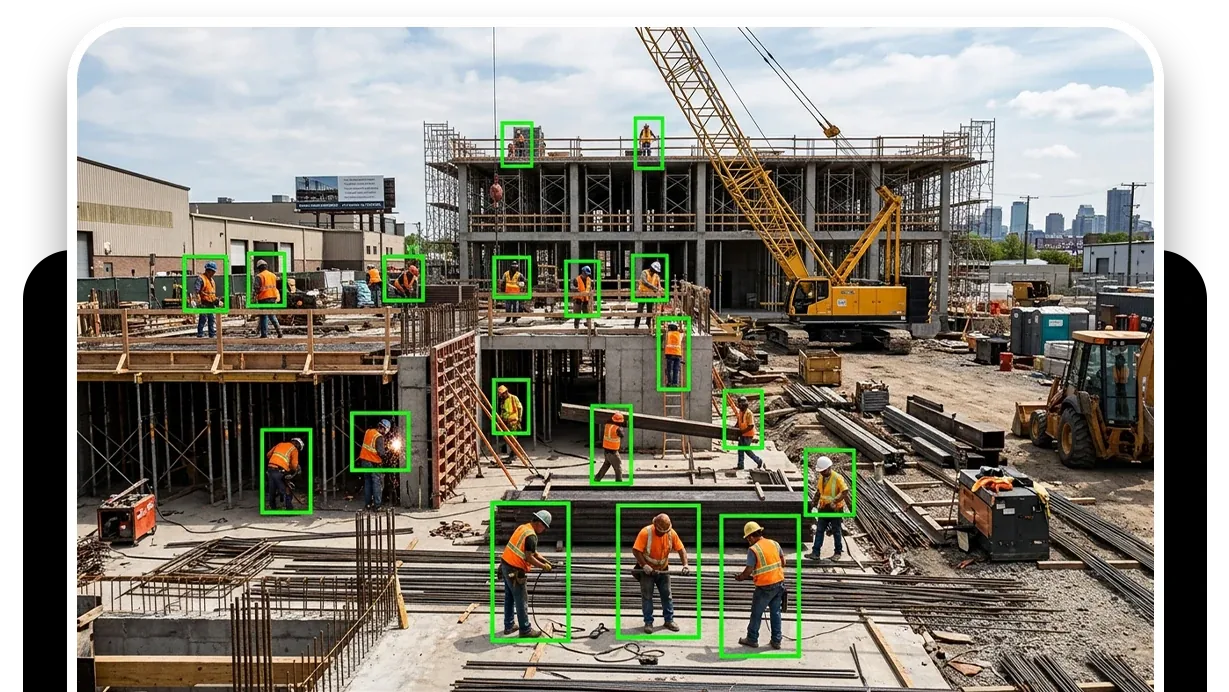
The injury is found by the next person past
None of it is a mystery afterwards; all of it was on camera.
- Someone falls in an aisle at the far end of the warehouse and lies there until a colleague happens by.
- A fire exit is blocked by a pallet for a week because the walk-through is monthly.
- A contractor steps inside the press exclusion zone and nobody sees it, so it becomes normal.
Safety monitoring has depended on the safety officer being in the right place, and a site has one safety officer and forty cameras.
- 01Fall in aisle C
- 02Detected on the track
- 03Nearest guard alerted
- 04Logged with the clip
Events raised live. Conditions checked on the round.
The detections raise the events live.
- Slip and fall detection watches the movement pattern of each confirmed person and raises an alert with a clip when it matches a fall, routed to the nearest guard so someone attends rather than someone eventually notices.
- Zone intrusion detection covers exclusion zones around machinery and vehicle lanes.
- PPE violation detection checks hats, vests and gloves against the policy for each zone; the PPE compliance page covers that check in depth.
The conditions that do not announce themselves, a blocked exit, a stacked walkway, an obstructed extinguisher point, are checklist items on a patrol round.
- Each is judged from the frame at each stop and recorded with it.
- Abandoned object detection catches the pallet left in the route between rounds.
- An automated round raises a critical notification for a risk it sees that no item asked about.
Slip and fall detection
A fall on a person's track, raised with a clip and routed to the nearest guard.
DetectionZone intrusion detection
Exclusion zones around machinery and lanes; a tracked person inside during the hours you set.
DetectionPPE violation detection
Hats, vests and gloves checked per person against the zone policy.
DetectionAbandoned object detection
An object left in a walkway or escape route past a dwell time you set.
- Walkway unobstructedCompliant
- Fire exit clearCompliant
- Exclusion zone emptyNot compliant
- Spill or debris on floorCompliant
A failed item is resolved as Fixed or Pending before the round can close.
What a safety round checks
A safety sequence walks the cameras over the working areas and asks the questions a safety officer asks on a walk-through.
- The items are walkway clear, exit clear, zone empty, floor dry, extinguisher accessible.
- Run at shift start and mid-shift, it produces a report per round with a frame per item.
- That is the site as it was rather than as it was remembered.
The report is what an inspector, an insurer or a claimant's solicitor asks for, and it exists before they ask.
A check found Not Compliant captures a snapshot and messages the guard designated for that camera; on a manual round the operator chooses to send it, on an automated round it goes on its own. The item stays Pending until it is marked Fixed, which captures the after frame, and the report shows both.
The footage around every frame in that report stays under the camera's own retention window on cloud video surveillance, on the same account, so the still and the video it came from are never in two systems.
What it will not do
It works from what the camera shows and hands the rest to people.
- It will not replace the safety officer, first aid or the reporting process; it starts them sooner.
- It will not see a fall on a camera pointed at the ceiling or in an area without a camera.
- It will not detect a chemical, a gas, a noise or a temperature.
- It does not identify anyone; a fall alert shows a person falling, not who.
We do not publish detection accuracy or injury-reduction figures. The trust page sets out the policy.
Industries where this applies
Frequently asked questions
Ready to patrol your site 24/7?
Book a 15-minute demo and see a live patrol run on your own cameras.