

Behavioral anomaly detection
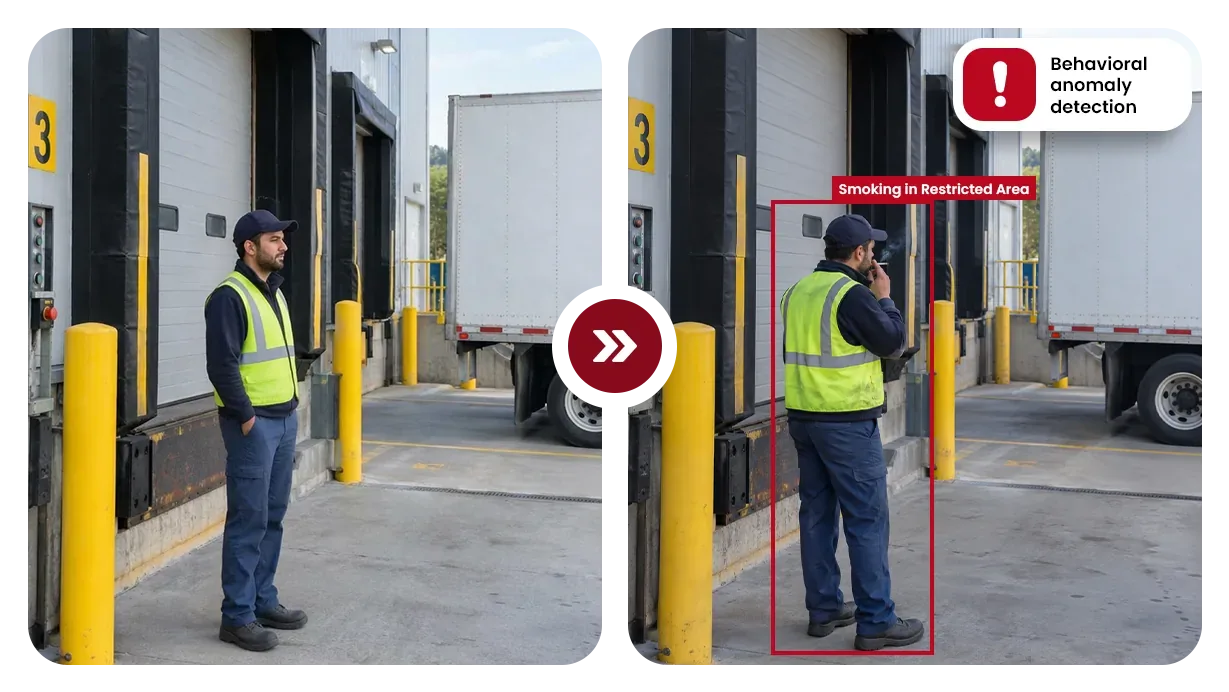
Describe the behavior you want watched, in your own words, and Camzify monitors for it. Type “alert me if anyone starts fighting” or “tell me if someone is smoking in the loading bay”. Natural-language processing interprets what you have asked for, the system watches the people appearing in the cameras you selected, and a notification is raised when that activity is observed.
- Describe the behavior in plain language
- No rule syntax, no zones to draw
- Watches the cameras you pick for it

Every other detection model on the platform is built for one job decided in advance. This one is defined at the point of use, which means you are not restricted to the behaviors someone anticipated when the catalog was written.
Describe it the way you would say it
There is no rule syntax and no zone geometry to draw. These are the kinds of descriptions operators actually write, and what each one puts the system on watch for.
“Alert me if anyone starts fighting”
Watches for
Physical altercation between two or more people
“Tell me if someone is smoking in the loading bay”
Watches for
Smoking in a zone where it is prohibited
“Notify me about vandalism or damage to property”
Watches for
Deliberate damage to fixtures, vehicles or signage
“Watch for anyone climbing the fence”
Watches for
Trespassing over a boundary rather than through a gate
“Flag people hanging around the entrance after closing”
Watches for
Sustained presence with no apparent purpose
“Let me know if someone is tampering with the cameras”
Watches for
Interference with equipment
How it works
Interpreting the description
Natural-language processing turns what you typed into what the system should watch for. Two differently-worded descriptions of the same behavior resolve to the same monitoring, so you do not have to learn a phrasing convention.
Watching the subjects
The people appearing in the selected views are tracked using multi-object tracking, so a subject keeps a persistent identity across frames while their behavior is assessed against the description rather than judged from a single frame.
Raising the notification
When the described activity is observed, an alert enters the notification queue naming the camera, the time and which description it matched, routed to the contact assigned to that camera.
Why this matters operationally
Every site has behaviors that matter locally and appear on no vendor’s feature list.
- Someone smokes beside a fuel store.
- People climb on stacked pallets.
- Someone props open a fire door.
These are obvious to whoever runs the site and invisible to a fixed model catalog. Historically the only options were to accept the gap or commission a custom model. Describing the behavior in a sentence removes that trade-off, and it means the system can be adjusted by the person who understands the site rather than by the vendor. Where a sentence is not enough, a custom detection can still be built to order.
In a patrol round
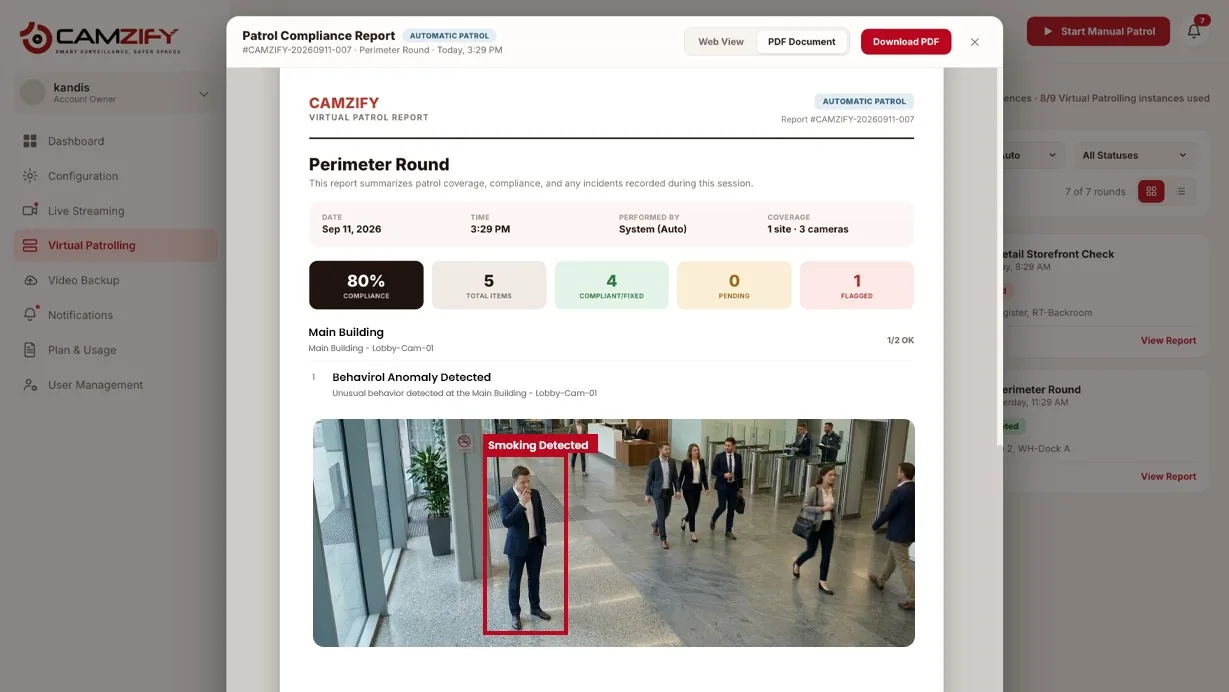
Behavioral alerts run continuously rather than only at patrol time, but they feed the same record. Anything flagged between rounds is logged against the relevant camera in the next patrol report, so the round reflects what happened while nobody was checking rather than only what was true at the moment of the check.
The footage around each alert is kept under the camera's own retention window on cloud video surveillance, so the clip and the recording it came from are on one account.
Industries using this
Related detections
Frequently asked questions
See the detections on live cameras
A 15-minute demo of the live product: the detections your site needs, running on real camera feeds, and a quote per camera for your sites.