

Camzify vs Spot AI
Spot AI sells an AI camera system: NDAA-compliant cameras supplied at no cost, an Intelligent Video Recorder on site, and a cloud dashboard with pre-trained AI agents on top. Camzify is software only, a cloud video surveillance service that runs on the ONVIF and RTSP cameras a site already owns, adds AI detections, and runs scheduled virtual patrol rounds with a compliance report per round. If you are looking for a Spot AI alternative that keeps your cameras and leaves a record of what was checked, this page sets the two side by side from each vendor's own pages.
Both connect to existing IP cameras, so the choice is not about lock-in. It is about two models of watching. Spot AI's AI Security Guard monitors every feed continuously and acts when it verifies a threat; Camzify's virtual patrolling runs a round on a schedule, checks a list at each camera, and files a timestamped report. The sections below say where each one wins.
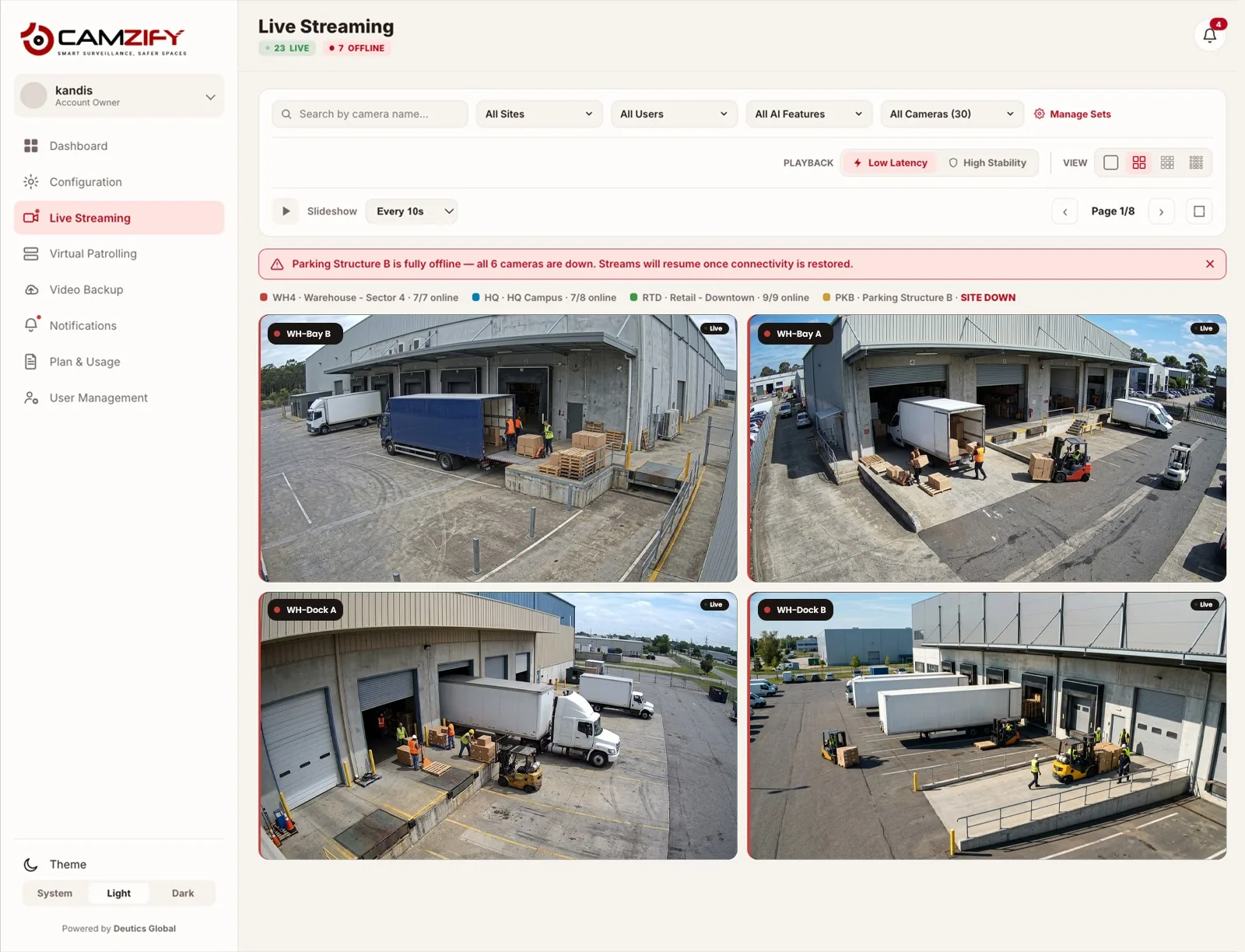
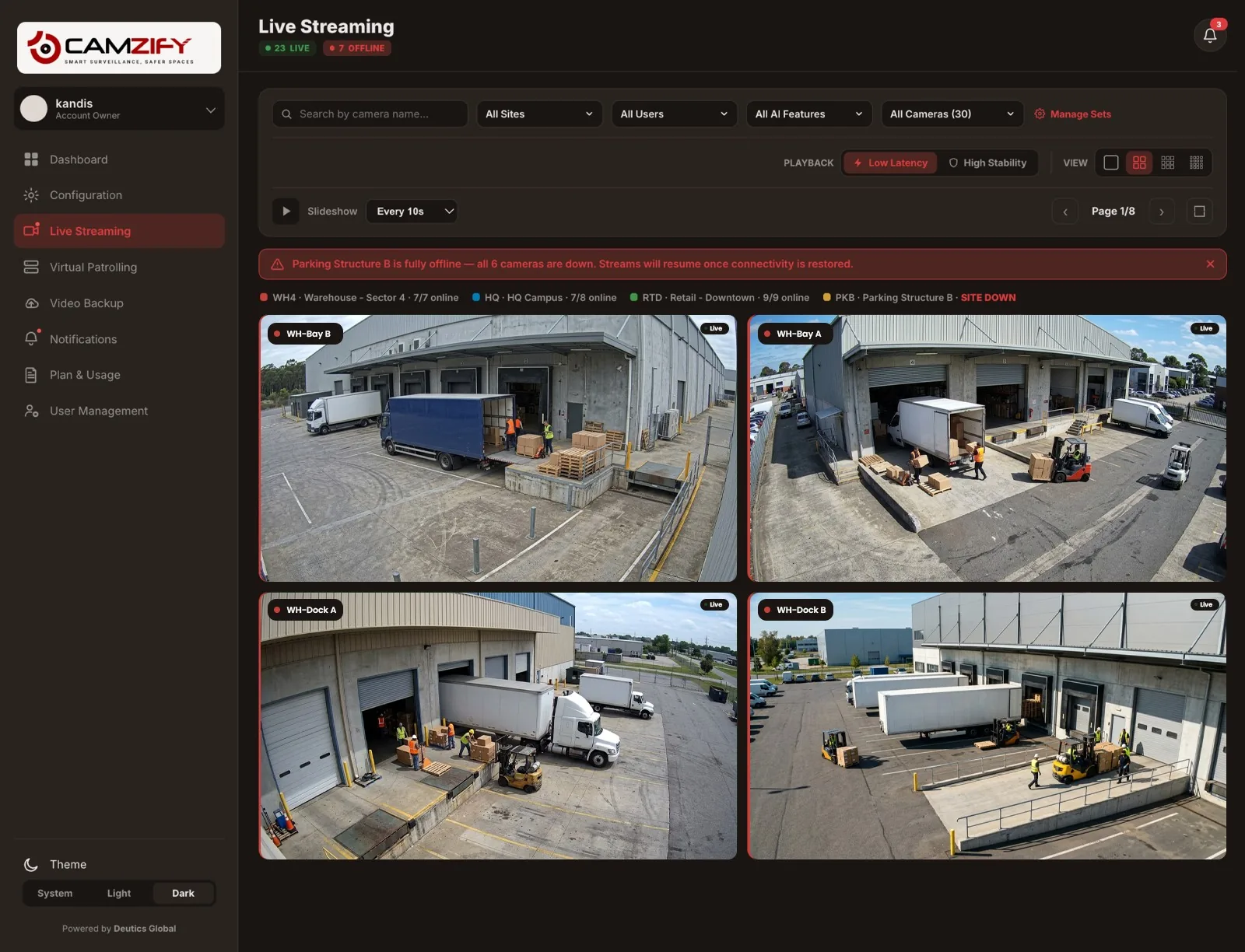
Side by side
The Spot AI column repeats what its own pages say and nothing else. Where a page did not state something, the cell says so rather than guessing.
| Aspect | Camzify | Spot AI |
|---|---|---|
| What you buy | A software subscription, priced per instance. No hardware is sold or required beyond the optional Camzify Connector on a PC. | An AI camera system: cameras, an Intelligent Video Recorder with on-device AI, and a cloud dashboard with pre-trained AI agents. |
| Cameras | The ONVIF, RTSP, RTMP or HTTPS cameras a site already owns. Nothing is supplied or replaced. | Its own NDAA-compliant cameras at no cost, or keep current cameras. States it runs on virtually any ONVIF-compliant IP camera across 100+ brands. |
| Recording and retention | Continuous or scheduled recording to the cloud, retention set per camera in days or as a storage cap, encrypted at rest with AES-256. | Full-resolution video stays on the on-site recorder and only metadata leaves the network, with cloud backup of selected clips. A retention period is not stated on the pages read. |
| AI detections | 23 detection models on confirmed object tracks, licensed per camera: intrusion, loitering, tampering, weapons, fire, PPE and behavior described in plain language. | 15+ pre-trained video AI agents grouped as AI Security Guard, AI Operations Assistant and AI Safety Manager. |
| AI assistant and search | Forensic search of recorded footage by a plain-language description of a person, and behaviors to watch for described in ordinary language. No conversational assistant. | Iris: ask what is happening across your facilities in plain language, and build custom video AI agents through conversation. |
| Patrol rounds and compliance reporting | Scheduled rounds with a checklist per camera, the guard notified on a failure, and a timestamped PDF report with a compliance percentage per round. | Continuous monitoring of every feed with escalating deterrents, clips, time-stamped logs and case files. No scheduled round with a checklist is described. |
| Multi-site and users | Every site on one login. Sub-users scoped to their own sites, permission groups per user, license quota allocated from the parent account. | Locations viewed from one dashboard. Role-based access with permissions set per camera and feature, and SSO or SAML sign-in. |
| Pricing model | Per instance per month, from $5 per camera, quoted per site within one business day. | No software price published. Cameras are stated to be at no cost; the Check pricing link opens a contact form. |
| Best fit | Sites with cameras worth keeping that need a verifiable round, and agencies or monitoring centers selling patrols to their own clients. | Sites that want cameras supplied, an on-site recorder, and one conversational assistant across security, safety and operations. |
Two models of watching
Spot AI describes its AI Security Guard as monitoring every camera feed, all the time, and deciding on its own how to act or alert. Its AI Operations Assistant applies the same idea to production lines and back-of-house tasks, and Iris lets a person ask the cameras questions in plain language. The output is events: verified threats, deterrents fired, clips and case files, and answers to questions asked after the fact.
Camzify's virtual patrolling is a round, not a filter. On a schedule set in the site's own timezone, the system visits each camera in a sequence, judges a checklist from the frame, messages the guard responsible for anything that fails, and files a report with the snapshot behind every answer and a compliance percentage. The 23 detections run alongside the round, but the record that a manager or a client reads is the report, and it exists whether or not anything happened.
The second difference is what arrives at the site. Spot AI can ship cameras at no cost and puts an Intelligent Video Recorder on the network, which keeps full-resolution video local. Camzify ships nothing; cameras stream to the cloud directly or through the Camzify Connector on a PC, and footage is stored under a retention window set per camera.
Where Spot AI is the better choice
- Cameras are supplied at no cost, so a site with aging or missing cameras gets hardware without a separate purchase or a second vendor.
- Iris answers plain-language questions about what is happening across your facilities and lets you build custom video AI agents through conversation, which Camzify does not offer.
- The AI Operations Assistant monitors production lines against a standard operating procedure, flags process drift in warehouses and scores shifts, an operations scope Camzify does not attempt.
- The AI Security Guard fires strobes, two-way talk-downs, floodlights or webhooks the moment a threat is verified and keeps escalating until the scene is clear; Camzify’s response is a notification to a named person.
- Its comparison library runs to forty pages, including switch guides that plan a phased migration and keep the cameras you own, which is more switching detail than most vendors publish, this site included.
Where Camzify is the better choice
- There is no hardware at all: nothing to ship, mount or replace, and a site with no room or appetite for a recorder needs none.
- A scheduled round with a checklist per camera produces a compliance percentage and a PDF report every time it runs, a record a client, an auditor or an insurer can read without opening any footage. That is the virtual guard model as a service.
- A failing check messages the guard responsible from the round itself, and an item cannot stay Not Compliant: it is fixed and re-checked with a second snapshot, or held Pending with a written reason.
- Multi-tenant sub-users let a security agency or monitoring center run each client scoped to its own sites, with license quota allocated from the parent account and a report per round for each client.
- Retention is set per camera in days or as a storage cap, so a gate camera can keep ninety days while a corridor keeps seven, and every site is on one login.
The bottom line
Choose Spot AI when you want one vendor to supply the cameras and the recorder, keep full-resolution video on site, and put a conversational assistant across security, safety and operations. Choose Camzify when the cameras are already in place and worth keeping, the question you are asked after an incident is whether the round was done, and the answer has to be a report with a timestamp on it. The detail on what a round records is on virtual patrolling, and the 23 detections that run alongside it are listed under AI features, with forensic video search as the nearest thing to Iris.
On cameras, both keep what you own; the difference is that Spot AI will also supply them and Camzify never will. Supported cameras lists what connects. On cost, use the ROI calculator to price the routine rounds a site runs today, then put your camera and feature counts into pricing for a quote. We do not characterize Spot AI's pricing beyond what its site states.
Sources, checked 17 September 2026
Every statement about Spot AI on this page comes from one of these pages, opened on the date above. Spot AI changes its site; if a cell above no longer matches, the page is the authority.
- Spot AI homepage: cameras at no cost, AI Security Guard, AI Operations Assistant, Iris
- Spot AI product: cameras, Intelligent Video Recorder, cloud dashboard, 15+ AI agents, ONVIF support
- Spot AI: AI Security Guard
- Spot AI: AI Operations Assistant
- Spot AI: Iris
- Spot AI: security, encryption, access control and certifications
- Spot AI: AI camera system buyer guide, with the Check pricing link
- Spot AI: the Check pricing destination, a contact form with no figures
- Spot AI: comparison library
- Spot AI: head-to-head comparisons
- Spot AI: switch guides
Frequently asked questions
Ready to patrol your site 24/7?
Book a 15-minute demo and see a live patrol run on your own cameras.